TL;DR
- The idea
- Pre-train a language model on unlabeled text, then fine-tune it on each specific task.
- Why it matters
- Raw text is abundant; the labeled data these tasks need is scarce and expensive.
- The result
- One task-agnostic model beat bespoke architectures on 9 of the 12 tasks studied.
- The legacy
- A single task-agnostic model from generative pre-training — the template every GPT inherits.
Labels are the bottleneck, not text
Raw text is everywhere; the labels that supervised models need are the expensive part.
Deep NLP models are data-hungry, but labeled data for learning these specific tasks is scarce, making it challenging for discriminatively trained models to perform adequately. The blocker was evidence, not ideas: it was unclear which optimization objective yields text representations useful for transfer. A pre-trained language model answers both questions at once — it gives an objective and a path to transfer learning.
Generative pre-training of a language model on a diverse corpus of unlabeled text, followed by discriminative fine-tuning on each specific task.
Two stages, one backbone
Learn from raw text once; adapt cheaply, many times.
First, a language-modeling objective on the unlabeled data learns the initial parameters of the network; then a supervised objective adapts those parameters to each task. Only the second stage spends labels, and it reuses the same weights — a single pre-train feeding many cheap fine-tuning runs.
A 12-layer decoder-only Transformer
No recurrence — masked self-attention plus feed-forward layers, all the way down.
The backbone applies a multi-headed self-attention operation over the input context tokens, followed by position-wise feedforward layers. Concretely it is a 12-layer decoder-only Transformer with masked self-attention (768-dimensional states and 12 attention heads). It learns on over 7,000 unique unpublished books, whose long contiguous passages teach long-range structure — and the pre-training itself is strong: a very low token-level perplexity of 18.4 on the corpus. The building blocks — self-attention, feed-forward layers, token embeddings, perplexity — are the same the Transformer introduced, wired as a decoder.
Change the input, not the architecture
Structured tasks are rewritten into one delimited token sequence the frozen model already understands.
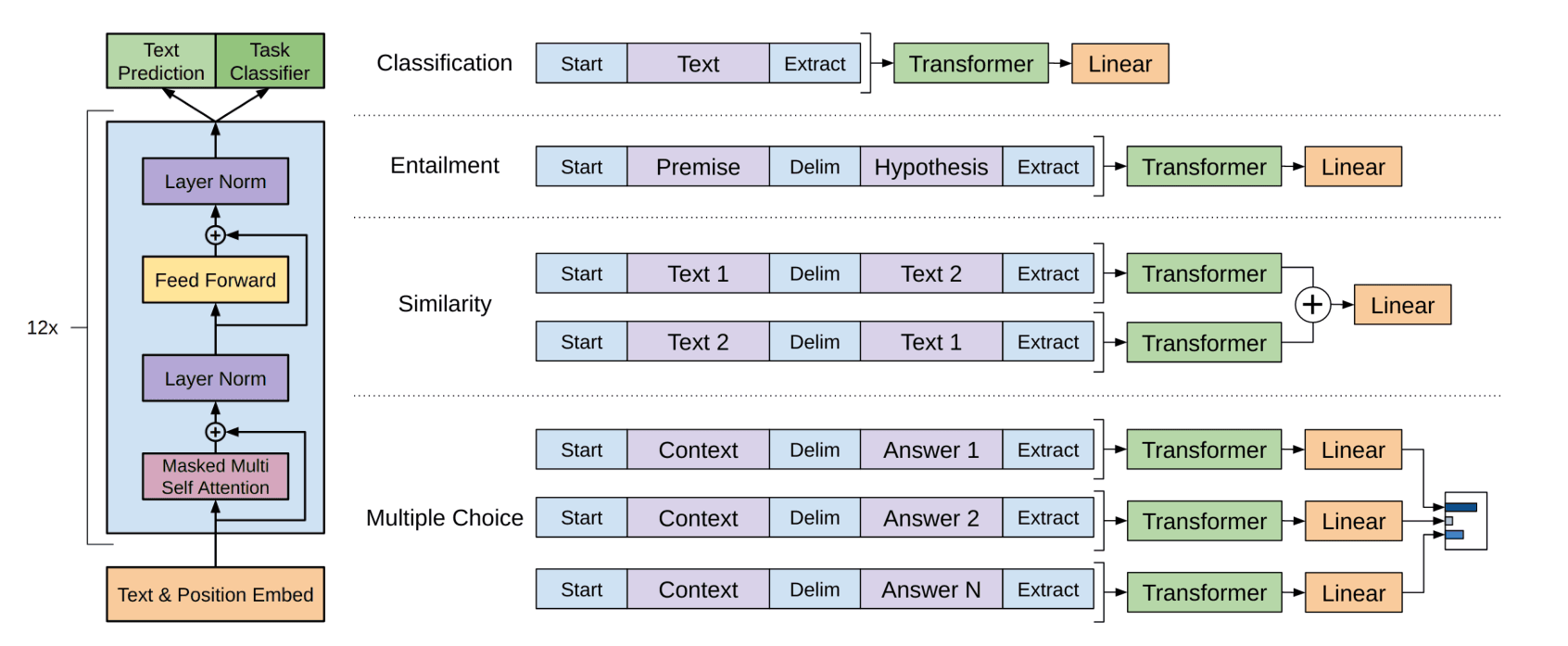
Rather than bolt task-specific modules onto the model, GPT uses traversal-style transforms that convert structured inputs into an ordered sequence the pre-trained model can process. All structured inputs become token sequences processed by the pre-trained model, followed by a linear+softmax layer. Pick a task and watch the raw input become chips:
A premise and a hypothesis, joined by a delimiter.
Every task threads the same frozen backbone plus one linear+softmax head — only the token layout changes.
§3.3 · Input TransformationsFigure 1 · caption
Here is the paper’s Figure 1 (left) — the decoder-only block itself — as an on-theme recreation:
New state of the art on 9 of 12 tasks
One task-agnostic model beats architectures built for each benchmark — with a few honest misses.
The single model lands absolute improvements of 8.9% on Stories Cloze, 5.7% on RACE, and 1.5% on MultiNLI. The biggest wins are where context runs long — up to 8.9% on Story Cloze and 5.7% overall on RACE — exactly the regime a Transformer handles better than a recurrent net.
Finetuned Transformer LM vs prior best
9 / 12 tasksThe one clear miss: on the small RTE set (2,490 examples) accuracy is 56%, below the 61.7 of a multi-task biLSTM.
Abstract · 9 of 12Table 2 · Results
Every transferred layer helps
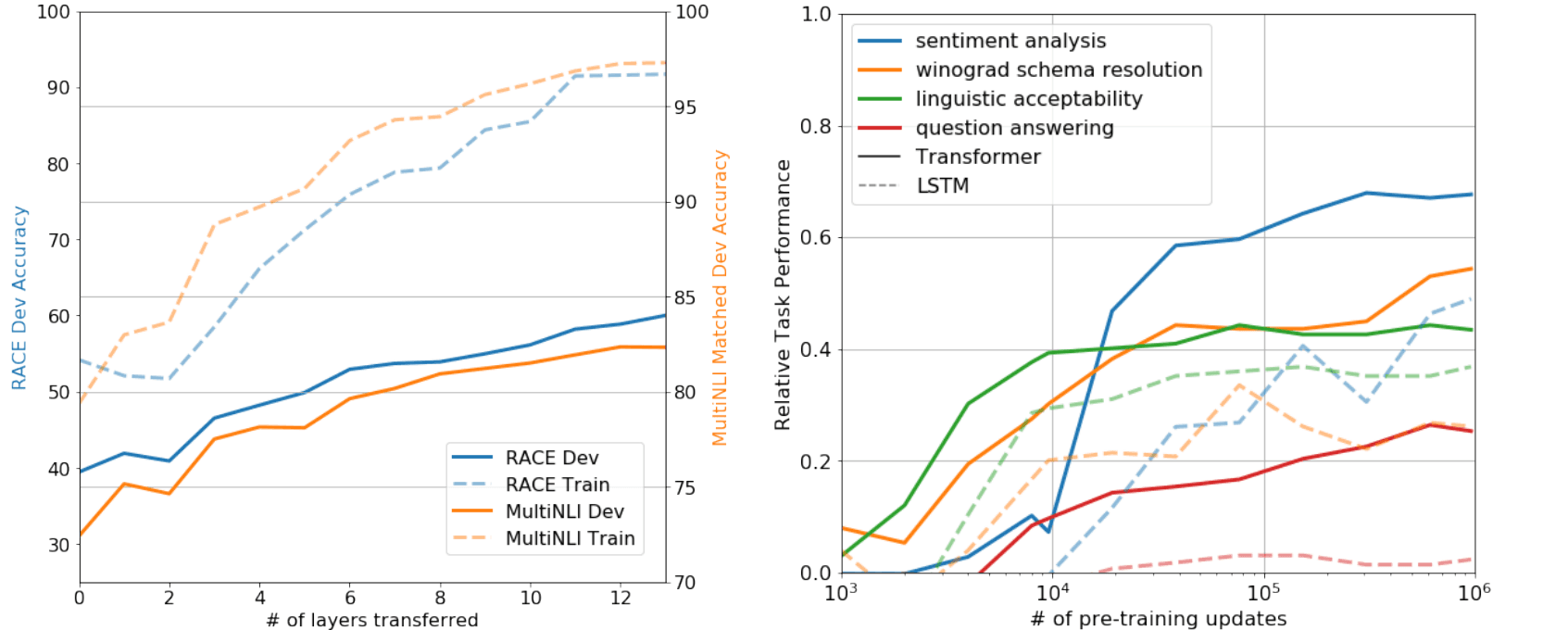
Transfer more of the pre-trained stack and accuracy keeps climbing — drag to see it.
Layers transferred
12
Each transformer layer provides further benefits, up to 9% for full transfer on MultiNLI.
Figure 2 · layers transferred
The paper’s own Figure 2 — the transfer curve (left) alongside zero-shot behavior growing with pre-training (right):
Pre-training is what carries the gains
Guess the cost of removing it, then see the cliff.
Strip out pre-training entirely — where does the average score land?
Transformer w/o pre-training vs full model
Average score across all tasks (Table 5)
The LSTM shows higher variance in zero-shot performance — the Transformer’s inductive bias assists in transfer.
Table 5 · Model ablations
Five things to remember
Labels are the bottleneck, not text.
Raw text is abundant while task labels are scarce and expensive — so learn from unlabeled books first, then spend labels only on a light adaptation step.
The motivating bottleneckWhy prior semi-supervised work stalled
One pre-train, many cheap fine-tunes.
Generative language-model pre-training on BooksCorpus, then discriminative fine-tuning on each task — a two-stage loop over a single Transformer-decoder backbone.
The recipe in one sentenceTwo-stage training procedureArchitecture: multi-layer Transformer decoderPre-training corpus: BooksCorpus
Change the input, not the architecture.
Structured inputs are rewritten into one delimited token sequence (Start · $ · Extract) so entailment, similarity, and QA all reuse the same frozen model plus a linear+softmax head.
Traversal-style input transformationsFigure 1 - inputs to token sequences
New state of the art on 9 of 12 tasks.
One task-agnostic model beats bespoke architectures — +8.9% Story Cloze, +5.7% RACE, +1.5% MultiNLI — losing clearly only on the tiny RTE set (56.0 vs 61.7).
Headline resultAbsolute improvementsLong-context QA gainsWhere it loses: RTE
Pre-training is what carries the gains.
Ablations show removing pre-training costs 14.8% across all tasks, each transferred layer adds up to 9% on MultiNLI, and the Transformer's inductive bias transfers better than an LSTM's.
Ablation - pre-training is load-bearingEvery layer helpsTransformer inductive bias helps transferConclusion