TL;DR
- The claim
- Frontier reasoning models face a complete accuracy collapse beyond a complexity threshold.
- The paradox
- Reasoning effort rises with complexity — then declines near the collapse, with tokens to spare.
- The shape
- Three regimes: non-thinking wins when easy, thinking wins in the middle, both collapse when hard.
- The mechanism
- Even handed the exact algorithm, the collapse stays put — it’s execution that breaks, not search.
Controllable puzzles, not contaminated benchmarks
Swap math benchmarks that may leak into training for puzzles where complexity is a clean dial.
Standard math and coding benchmarks conflate two problems: they may be contaminated, and their difficulty isn’t cleanly controllable. Instead the authors adopt controllable puzzle environments that let us vary complexity systematically — Tower of Hanoi, Checker Jumping, River Crossing, and Blocks World — where a simulator grades every intermediate move and the core logic stays fixed as size grows. That lets them inspect not just answers but the whole chain-of-thought trace.
These models still fail to develop generalizable problem-solving capabilities for planning tasks, with performance collapsing to near-zero beyond a certain complexity threshold.
Accuracy doesn't fade — it falls off a cliff
Every frontier reasoning model tested hits a hard wall where it scores essentially zero.
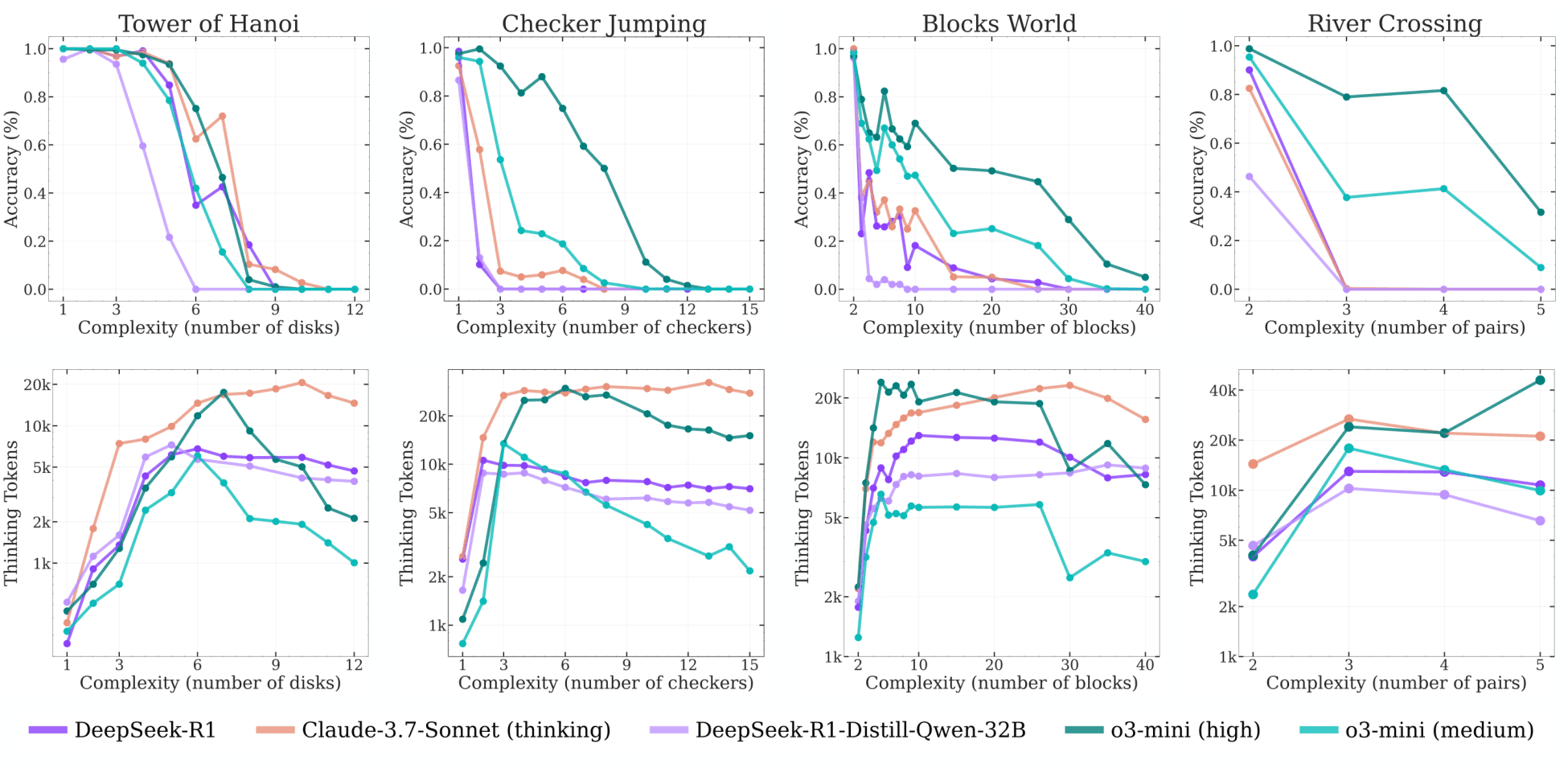
The central finding is not gentle degradation. Across diverse puzzles, frontier reasoning models face a complete accuracy collapse beyond certain complexities. These aren’t ordinary LLMs — they’re trained with reinforcement learning to self-reflect — yet past a puzzle-specific threshold their accuracy drops to near-zero and stays there. The hero chart above traces that shape; the widgets below let you drive it.
Thinking only pays off in a narrow middle band
Drag the complexity dial: extended thinking is wasteful when easy, decisive in the middle, useless when hard.
Matched under equal inference compute, the paper identifies three performance regimes: low-complexity tasks where standard models win, medium-complexity tasks where thinking shows a real advantage, and high-complexity tasks where both collapse.
Problem complexity
N = 6
thinking model wins (gap widens)
The only band where thinking pays off: extra reasoning tokens open a real accuracy advantage over the non-thinking twin.
§4.2.1 · Three Regimes of Complexity
Models think LESS right when they should think more
The thinking-token curve peaks and turns down at exactly the complexity where accuracy cliffs.
This is the counter-intuitive scaling limit. Near the collapse point, LRMs begin reducing their reasoning effort as problem complexity increases, despite operating well below generation length limits. It isn’t a budget cap — the 64k token allowance sits largely unspent. Pick a puzzle and watch the two curves diverge:
Accuracy vs. thinking tokens (Fig. 6)
Reasoning models initially spend more tokens while accuracy declines gradually — until a critical point where reasoning collapses and effort counterintuitively decreases.
§4.2.2 · Figure 6
What happens inside the thoughts
On easy puzzles the answer is found early then abandoned; on hard ones it never appears at all.
Because the simulator can grade every intermediate move, the authors locate where correct solutions appear along each trace. On simple problems, reasoning models often identify correct solutions early but inefficiently continue exploring incorrect alternatives — the “overthinking” mode. Past the threshold, the failure is total: complex problems (N≥8) exhibit consistently near-zero accuracy.
Each track is one reasoning trace, left (start) to right (end). Dots mark where a correct or incorrect candidate solution surfaces inside the model’s thoughts.
Correct answer found early — then the model keeps exploring worse alternatives.
Correct solutions arrive only late in the trace, after long exploration.
No correct solution appears anywhere — consistently near-zero, complete failure.
§1 · Overthinking§4.3 · Complete failure (N≥8)
It's execution that breaks, not search
Hand the model the exact solution algorithm and the collapse barely moves.
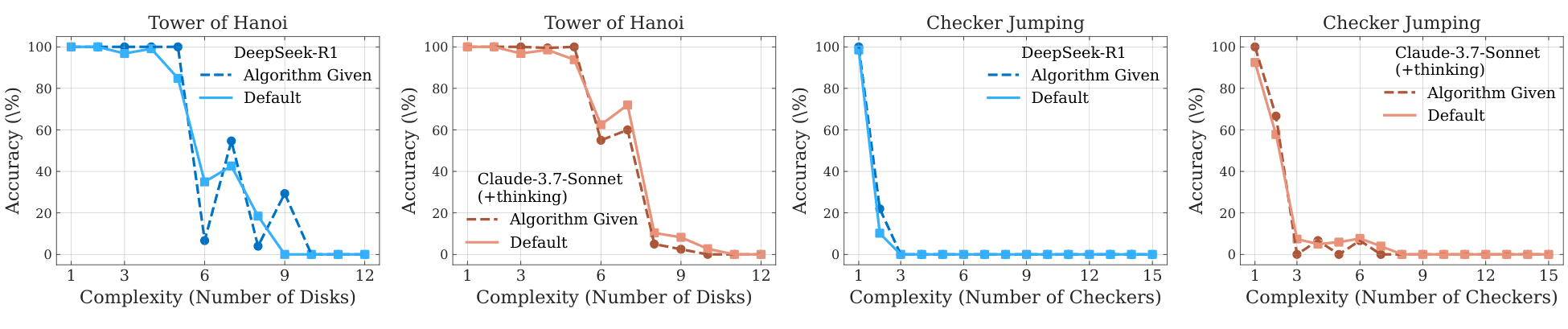
If the models failed because search is hard, giving them the recipe should help. It doesn’t. And it isn’t only a search problem in the first place — they fail to use explicit algorithms and reason inconsistently across scales and problems. The curves for “find it yourself” and “here’s the algorithm” sit almost on top of each other:
Give the model the algorithm? (Fig. 8)
Even when the algorithm is provided in the prompt — so the model only needs to execute the prescribed steps — performance does not improve and the collapse occurs at roughly the same point.
§4.4 · Figure 8
Familiarity, not difficulty, sets the wall
The same model executes 100 correct Hanoi moves but only 4 in River Crossing.
If the wall were about raw computation, harder-to-simulate puzzles would fall first. They don’t. The models show very different error-free sequence lengths across puzzles, performing up to 100 correct moves in Tower of Hanoi but only 4 in River Crossing.
Error-free moves before the first mistake
A 100-move Tower of Hanoi is “easier” for the model than a 4-move River Crossing — so the collapse point tracks how familiar a puzzle is from training, not how computationally hard it is.
§5 · Conclusion
What this study can and can't claim
The authors are explicit: puzzles are a narrow slice, and the models are black boxes.
The controlled setup is the paper’s strength and its limit. The authors note their puzzle environments represent a narrow slice of reasoning tasks, and that most of our experiments rely on black-box API access to the closed frontier models — so results may not generalize to open-ended reasoning, and no mechanistic look inside is possible. Read the collapse as a sharp, reproducible symptom, not a full theory of why.
Five things to remember
Accuracy doesn't fade — it falls off a cliff.
Beyond a puzzle-specific complexity, every frontier reasoning model tested collapses to near-zero accuracy on planning tasks.
Complete accuracy collapse beyond a complexity thresholdPerformance collapses to near-zero on planning tasksComplex problems: consistently near-zero, complete failure
Models think LESS right when they should think more.
Near the collapse point, reasoning effort turns down as problems get harder — despite sitting well below a 64k token budget.
Reasoning effort rises then falls with complexityNear collapse, models reduce reasoning effortFig. 6 — tokens rise then fall as accuracy collapses
Thinking only pays off in a narrow middle band.
Low complexity: non-thinking models win on efficiency. Medium: thinking helps. High: both collapse to zero together.
Three performance regimes vs. standard LLMsAt low complexity, non-thinking models match or beat thinkingAt high complexity, both model types collapse to zero
It's execution that breaks, not search.
Handed the exact solution algorithm in the prompt, models still collapse at roughly the same point — they can't reliably follow the steps.
Fig. 8 — giving the algorithm doesn't move the collapseFail to use explicit algorithms; inconsistent across scales
Overthinking on easy, familiarity over difficulty on hard.
On simple puzzles models find the answer early then wander off it; across puzzles the collapse point tracks training exposure — 100 correct Hanoi moves vs only 4 in River Crossing.
Overthinking: correct answer found early, then abandonedUp to 100 correct Hanoi moves but only 4 in River Crossing